Sarah Caillard
Visual artistSarah Caillard (Paris, 1988) lives and works in Brussels. She graduated from La Cambre, Brussels, in 2014, where she completed a Master's degree in Visual Arts, Sculpture and Video. She was awarded the Fondation Moonens Prize the same year. Her recent exhibitions include Concrete Sweethearts at CC Strombeek, Room Tone at STANCE Gallery in Stockholm, and Butterfly in the Stomach at Ruttkowski;68 in Cologne, among other solo and group exhibitions in Belgium and internationally. In September 2027, she will present a solo exhibition at Ruttkowski;68 in Paris, with whom she has also participated in Art Brussels and NADA Paris.
Sarah Caillard's practice brings together sculpture, drawing, painting, video and installation around a central question: how do images, gestures and narratives become inscribed within us? At the core of her work is the idea of the imprint, understood as physical trace, memory and invisible transmission. She is interested in what inhabits us and precedes us: myths, archetypes, popular images, memories and collective narratives.
The body occupies a central place in this research. Cast, fragmented, distorted or glitched, it becomes a site where different forms of haunting and transmission meet. Caillard re-enacts poses drawn from art history and contemporary culture, bringing ancient icons, pop imagery and intimate imaginaries into contact.
For the exhibition Sous Influence, Sarah Caillard presents two sculptures, Concrete Sweethearts 1 and Levante, each re-enacting a canonical figure of Western art history: the reclining nude and the Venus. Both belong to a long tradition in which the female body is constructed as an object for the gaze. Yet in Caillard's sculptures, the figure is no longer offered to view as a complete body. It appears instead as an imprint, an absence, a formal ghost.
In the first room, Concrete Sweethearts 1 stages the reclining nude in a state of duplication. The sculpture on the floor enters into dialogue with a wall piece that reprises the archetypal elements of the same figure, as though the body were doubling itself - or remembering itself - across the space. Moulding is central to this transformation. Rather than modelling or carving the body, Caillard registers it through contact, preserving its trace while simultaneously revealing its disappearance. The classical pose begins to glitch: the body interferes with itself, fragments, and slips out of its expected form. Marked by its own imprint, it becomes both present and partially undone, a body escaping the conditions through which it has historically been represented, even as it remains caught within them.
Concrete and stainless steel intensify this tension. Set against an industrial structure, the bodily imprint appears at once massive and vulnerable, fixed and unstable. The roughness of the surface, its accidents and ruptures, introduces a sense of temporality: the body seems to form, erode, and disappear simultaneously. Embedded within the concrete, lace functions as a second skin, bringing the delicacy and coded memory of ornament into contact with the hardness of an industrial material.
Across both sculptures, retro-reflective microbeads gather across the surface like drops, becoming fully visible only in relation to light and to the movement of the viewer. The presence of the body therefore remains unstable, never entirely given. In Levante, this fluctuation is attached to the figure of the Venus itself: her surface flickers and withdraws according to the angle from which she is seen, making visibility a condition of movement rather than a fixed state.
Caillard does not simply quote historical poses; she displaces the conditions of their visibility. The reclining nude and the Venus, traditionally associated with idealisation and the availability of the female body to the gaze, become sites of tension between presence and absence, visibility and erasure, memory and transformation. The sculptures retain the gestures of these familiar figures while making them glitch. What initially appears recognisable becomes strange, unstable, almost uncanny.
The body is no longer presented as an object to be looked at, but as a trace that looks back through its own disappearance. By preserving the gesture while disrupting its visual codes, Caillard turns the classical figure into a site of resistance, where inherited images and postures are not erased but made unstable, exposing the ways in which they continue to shape the way we see.
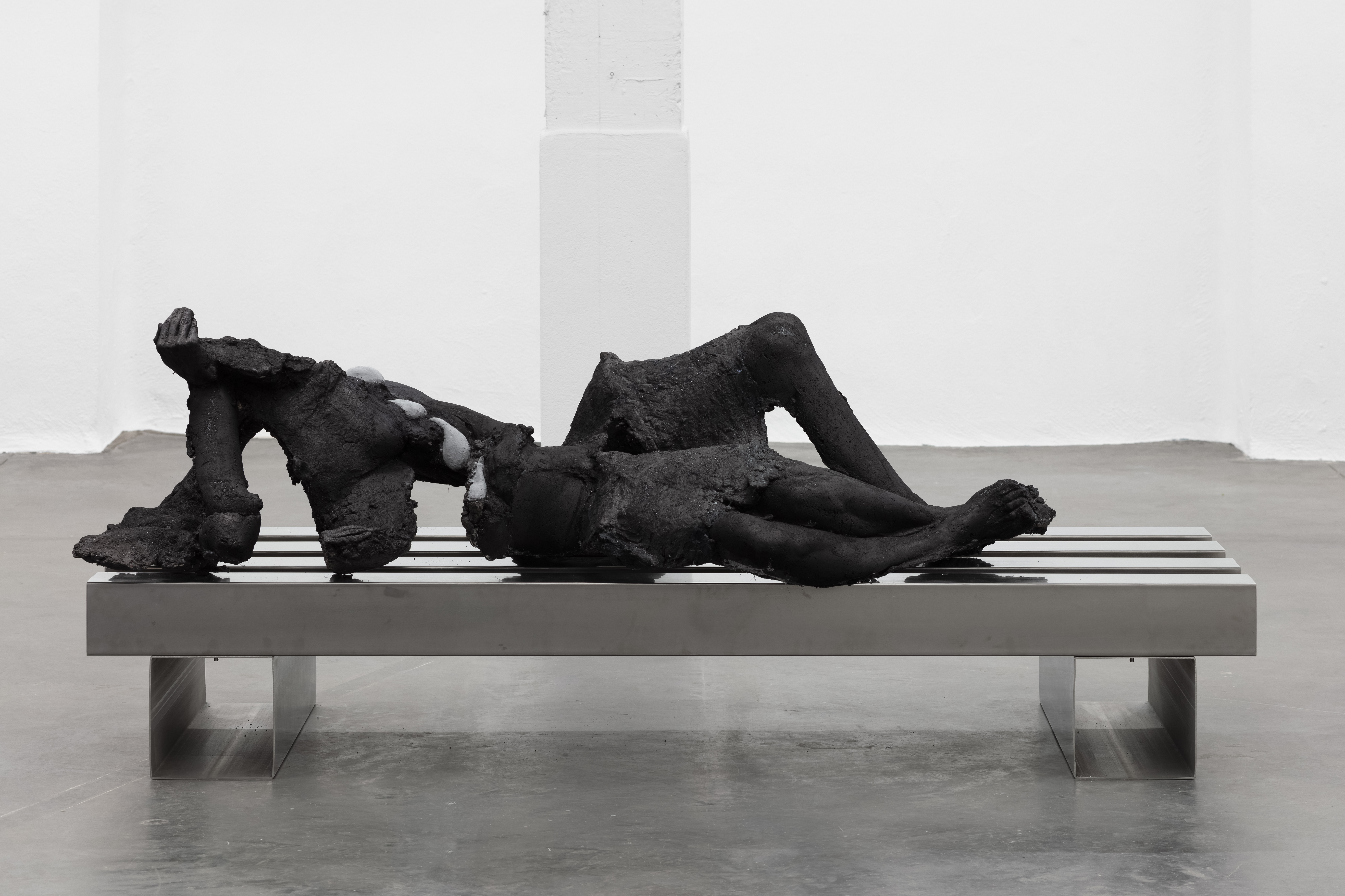
CONCRETE SWEETHEARTS 1, 2026
Stainless steel, reinforced concrete, glitter, pigments, steel, retro-reflective microbeads, carborundum
70 x 200 x 60 cm