Denys Shantar
Visual artistDenys Shantar (*1997, Kherson, Ukraine) is a Ukrainian-Swiss artist and researcher, with a background in theater and Eastern Orthodox religion.
In 2019 he graduated with a Fine Art Bachelor's from the Zurich University of the Arts (CH) with a focus on Photography. In 2021, he finished his Master's degree in Costume Design at the Royal Academy of Fine Arts Antwerp (BE).
He exhibited in several international institutions and galleries, including MHKA Museum Antwerp (BE), Z33 House for Contemporary Art Hasselt (BE), Helmhaus Zurich (CH), Galerie für Zeitgenössische Kunst Leipzig (DE), Rijksmuseum Meermanno (NL), Textile Museum Texture Kortrijk (BE) and Zilberman Gallery (DE).
He received the Emerging Artist Award during the 25th Gabrovo Biennial 2022 in Bulgaria. Additionally, he was granted the Royal Academy Antwerp Department Prize in Costume Design in 2021 and the CC Brugge Input/Output Aanmoedigings Prize in 2023.
From September 2023 to September 2024, he conducted his one-year starter research project “God save the Queers” at the Royal Academy in Antwerp. The results were presented at Cas-co Leuven (BE) finalizing his Off the Grid Residency. His research project was approved for another year from September 2025 under the title “God save the Queer(s)”.
He lives and works in Antwerp.
In his artistic practice, Denys Shantar draws on his experiences as a queer Ukrainian immigrant growing up in an Eastern Orthodox religious community in Zürich and his search for belonging, identity, and healing. He works mainly with textile collaging, using recycled materials to create new, personal narratives that often reference Byzantine and Catholic iconography, as well as monumental works of the Soviet period.
Shantar's ongoing research into Christian saints plays a central role in his work. He intertwines their stories with his own upbringing and queer perspective, linking the personal to current socio-political and historical events. Religion was - and always will be - political. Shantar uses this to his advantage, confronting the institution of the church with its own weapons. For him, the bodies of saints, queer bodies, and artistic bodies of work share parallels, beginning with societal and institutional oppression and leading to the reclamation of power over one's own body and story.
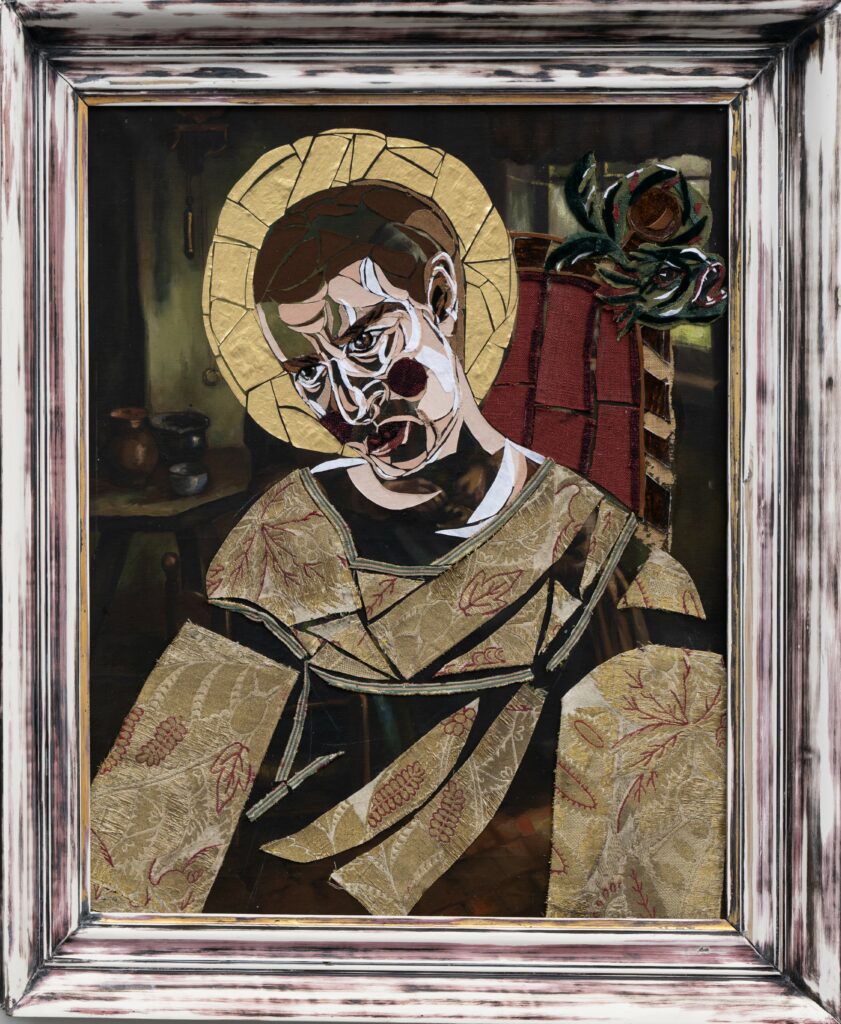
PROPHET JONA AFTER ECSTASY, 2025
Textile collage on found canvas with frame
72 x 62 cm
Installation view, KADOC Leuven, 2025