Marco Emmanuele
Visual artistIn recent years, Marco Emmanuele has established himself as a distinctive figure within the contemporary Italian art scene. His work has been presented in major institutions such as MAXXI in Rome, Fondazione Pastificio Cerere, the Biennale di Gubbio, and the Museo d’Arte Moderna e Contemporanea di Anticoli Corrado. A finalist for the Premio Cairo in 2023, he has also undertaken artist residencies in Paris and Milan.
His practice takes shape through materials that are never neutral, but instead carry within them a history of tensions: fragility and resistance, loss and persistence. Glass powder, what remains after fracture, is not a mere residue, but a threshold, a liminal condition in which waste and possibility coincide. On canvas, this material settles like a sensitive skin, a field of refraction where light does not simply illuminate: it retains memory and renders visible what has emerged from rupture.
The sculptures in sand and fused glass extend this state of instability. Sand, an elemental and inherently unstable substance, and glass, a material transformed through an irreversible process, coexist in suspended forms balanced between permanence and dissolution. These are not finished objects, but structures traversed by an internal tension, where error, crack, and asymmetry are not flaws, but sites of meaning.
Within the framework of The Paradoxes of Abundance: Between Treasure and Ruin, his work inhabits the space of what remains—what persists after excess and after collapse. Fragments, traces, and accumulations of matter and light become devices of memory. Abundance does not appear as the promise of fullness, but as an ambiguous condition already permeated by the possibility of loss. Ruin does not occur afterward; it is inscribed within the very process itself, in pulverization, fusion, and constant exposure to fracture.
The beauty that emerges is neither intact nor definitive. It is a fragile beauty, arising through gestures of transformation and repair, in an attempt to hold together what tends to disperse. The works do not evoke an idealized nature, but rather a wounded material that continues to exist, to reflect, and to resonate. In this sense, glass and sand become figures of a living and vulnerable earth, mirroring our own condition: unstable, contradictory, and yet still capable of light.
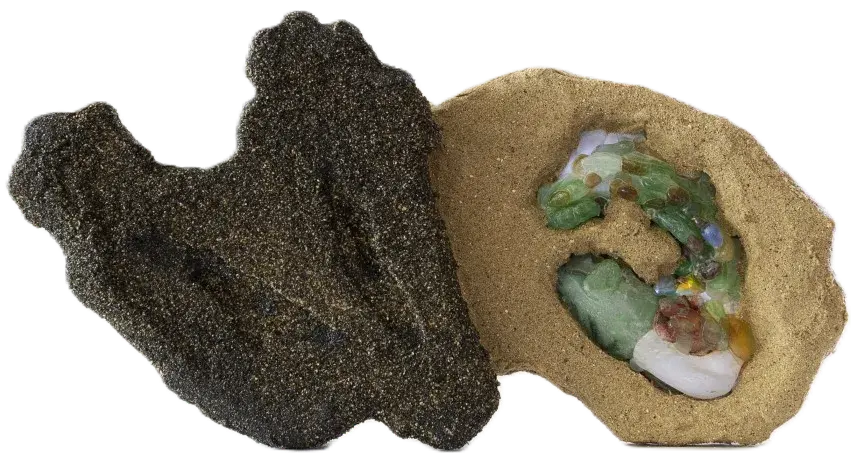
NULLA È ESOTICO, TUTTO CI APPARTIENE, 2023
Glassfusing and sand on wood
28 x 14,5 x 5 cm